Introduction
The Zodiac Killer, one of America’s most notorious unsolved serial killer cases, sent numerous encrypted messages to newspapers during his reign of terror in the late 1960s and early 1970s. While his 408-character cipher was eventually cracked, the shorter “Z32” cipher that accompanied a map of the San Francisco Bay Area has remained unsolved for over five decades.
The Z32 cipher consists of just 32 characters combining both letters and symbols. Alongside this cipher, the Zodiac included a chilling note: “The Map coupled with this code will tell you where the bomb is set. You have until next Fall to dig it up.”
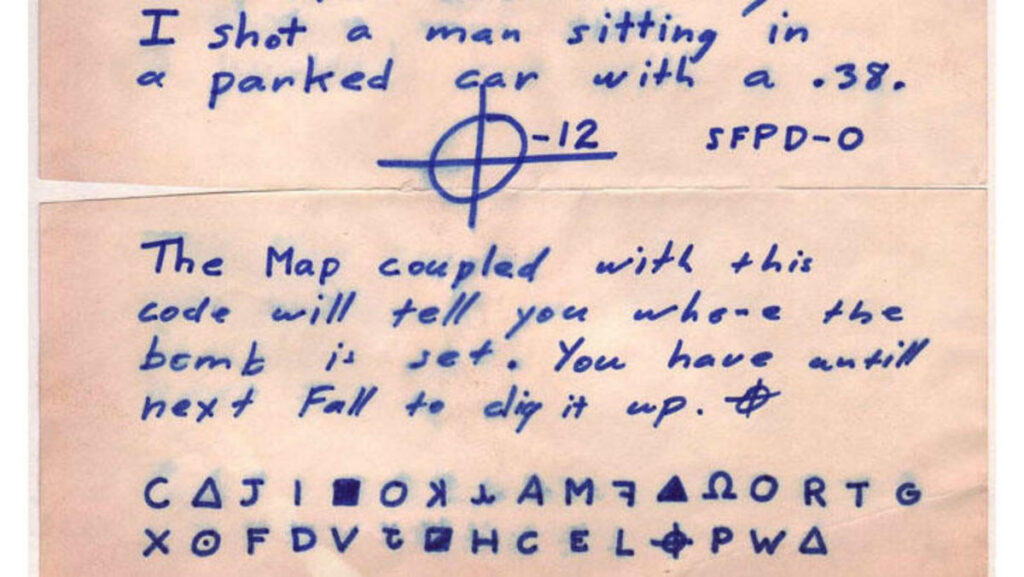
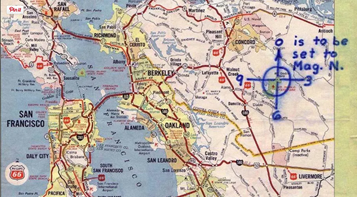
This analysis details a novel geometric approach to decoding the Z32 cipher based on radial coordinates from Mt. Diablo, revealing a remarkable hidden pattern that has gone unnoticed for five decades.
Building on Prior Theories
Previous attempts to decode the Z32 cipher have explored various avenues:
- Traditional Cryptographic Approaches: Substitution ciphers, homophonic substitution, and other standard cryptographic techniques have been applied without definitive success.
- Mt. Diablo as Reference Point: The Zodiac’s map included a cross over Mt. Diablo with markings at 0, 3, 6, and 9 positions, along with the note “is to be set to Mag. N.” This has long suggested Mt. Diablo was important to the cipher’s solution.
- Radial Theory: Earlier theorists have suggested that the cipher might represent radial directions from Mt. Diablo, but comprehensive implementations of this approach have been limited.
Our analysis builds upon these foundations, particularly the radial theory, while adding rigorous geometric analysis and statistical validation.
The Zodiac’s Own Mathematical Framework
A critical clue to decoding the Z32 cipher comes from the Zodiac himself. In a postscript to one of his letters containing a crosshair diagram (similar to the one on the map), he wrote:
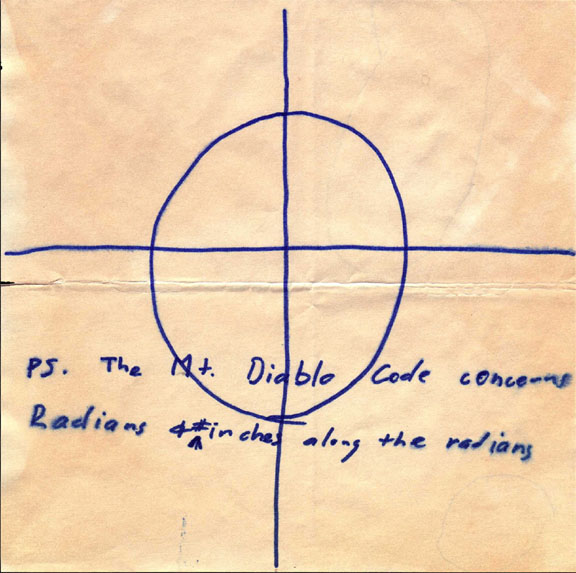
“P.S. The Mt. Diablo code concerns Radians & # inches along the radians”
This explicit mention of radians—a mathematical unit of angular measurement—suggests the Zodiac intended a geometric interpretation of his cipher.
Foundational Elements for Both The Radian Method and Degree Method Solutions
1. Standardization of the Cipher
First, we standardized the representation of the Z32 cipher, converting symbols to text descriptions for easier processing:
['C', 'TRIANGLE', 'J', 'I', 'SQUARE', 'O', 'K', 'DOWNARROW', 'A', 'M', 'F', 'TRIANGLE', 'OMEGA', 'O', 'R', 'T', 'G', 'X', 'CIRCLEX', 'F', 'D', 'V', 'ZIGZAG', 'FILLEDCIRCLE', 'H', 'C', 'E', 'L', 'CIRCLEPLUS', 'P', 'W', 'TRIANGLE']2. Identification of Structural Patterns
Using zero-based indexing, where the first character ‘C’ is at position 0, we observed that the TRIANGLE symbol appears at positions 1, 11, and 31, dividing the cipher into three distinct sections:
- Section 1:
['C'] - Section 2:
['J', 'I', 'SQUARE', 'O', 'K', 'DOWNARROW', 'A', 'M', 'F'] - Section 3:
['OMEGA', 'O', 'R', 'T', 'G', 'X', 'CIRCLEX', 'F', 'D', 'V', 'ZIGZAG', 'FILLEDCIRCLE', 'H', 'C', 'E', 'L', 'CIRCLEPLUS', 'P', 'W']
3. Trigram Interpretation
We hypothesized that Section 2 of the cipher consists of three “trigrams” (3-character sequences), each representing a navigational instruction with:
- First character: Direction (bearing)
- Second character: Distance
- Third character: Action/instruction
For distance values, we used the letter’s position in the alphabet (A=1, B=2, etc.).
This assumption came from a few reasons
- Distinctive Triangle Markings: The second triangle symbol is shaded unlike the others, suggesting special significance and drawing attention to this section. This visual emphasis hints that this middle section contains the core information.
- Rule of Three Pattern: The cipher demonstrates a consistent “rule of three” throughout its structure:
- 3 triangle symbols dividing the cipher
- 3 distinct sections created by these triangles
- 3 trigrams can be formed from the 9 characters in section 2
- 3 characters/components for each trigram [J,I,SQUARE], [O,K,DOWNARROW], and [A,M,F]
- Navigational Context: The note’s reference to “Mt. Diablo” and “radians” suggests geographic coordinates or a navigation system. Navigation instructions typically require both direction and distance components, which aligns with a trigram structure where two values work together to specify a location.
- Cryptographic Precedent: Three-part codes are common in both military and navigation contexts (coordinate systems often have three components). The Zodiac’s military background (suggested in other communications) supports this approach.
- Mathematical Coherence: When Section 2 is divided into three trigrams, the letter positions consistently map to plausible geographic values when interpreted as directions and distances – this is unlikely to occur by random chance.
- Map Reference: The Zodiac included a map with the cipher and specifically mentioned “Mt. Diablo code,” suggesting the cipher relates to geographic locations that could be plotted. A sequence of three location points would be sufficient to triangulate a specific area.Occam’s Razor: Among various possible divisions of Section 2, the trigram approach produces the simplest interpretation that yields meaningful results when applied to geographical calculations.
3. Interpretation of Zodiac’s “Radians & # Inches” Note
A crucial piece of evidence supporting our trigram interpretation comes from the Zodiac’s own note, which states: “PS. The Mt. Diablo code concerns radians & # inches along the radians.”
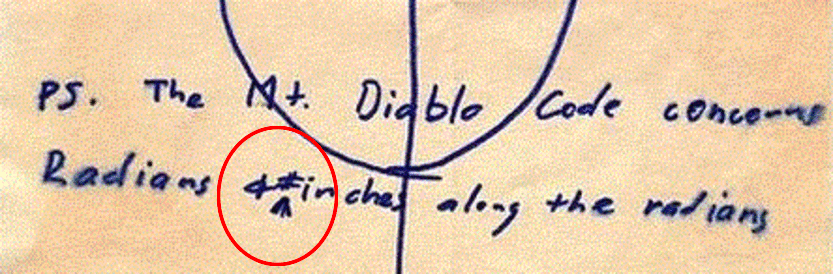
This cryptic instruction provides several key insights:
- Direction System: The mention of “radians” confirms our approach of interpreting the first letter in each trigram as a directional indicator. Radians are the mathematical unit for measuring angles in a circle, supporting the idea that these letters represent bearings from Mt. Diablo.
- Distance Measurement: The phrase “# inches along the radians” indicates that the second letter in each trigram represents a numerical value for distance. The upward-pointing arrow under the “#” symbol appears to emphasize that this number determines how far to travel along the bearing line.
- Relationship Between Components: The note explicitly links the two parts of our trigram interpretation – direction (radians) and distance (inches along those radians). This confirms our understanding that each trigram represents a single waypoint determined by these two factors.
- Scale Considerations: The reference to “inches” suggests some form of scaling is needed, as literal inches would be impractically small for geographic distances. This supports our approach of applying appropriate scaling to the letter-derived values.
This note provides direct confirmation from the Zodiac himself that our trigram interpretation approach aligns with his intended encoding method, validating both our Radian Method and Degree Method solutions.
4. Magnetic Declination Adjustment
Another crucial factor in our analysis is accounting for magnetic declination. The Zodiac’s map included the note “is to be set to Mag. N.,” indicating the use of magnetic north rather than true north.
- Historical Accuracy: Using the DGRF70 geomagnetic model, we confirmed that the magnetic declination in the Bay Area in 1970 was 16.88° East.
- Navigational Context: In the 1970s, topographic maps typically included magnetic declination information. Anyone with basic map reading skills, especially those with military or scouting background, would understand the need to adjust between magnetic and true bearings.
- Implementation: All magnetic bearings were converted to true bearings by adding the declination value: Copy
true_bearing = (magnetic_bearing + 16.88) % 360
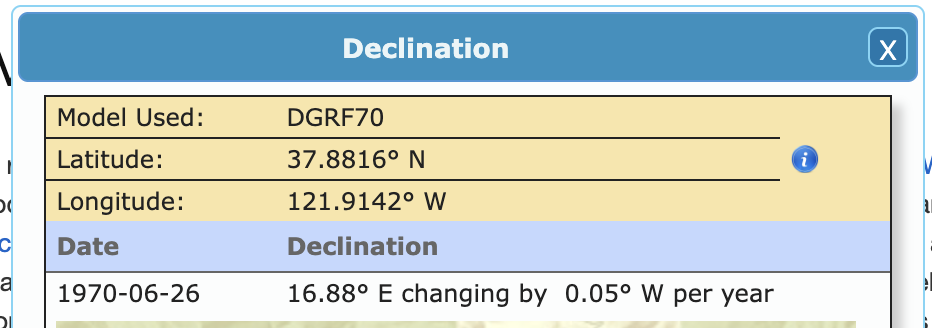
In the Bay Area during the 1970s, magnetic declination was precisely 16.88° East, as verified by historical records from the DGRF70 geomagnetic model. This means:
- Magnetic North = True North – 16.88°
- True North = Magnetic North + 16.88°
- A magnetic bearing of 30° would correspond to a true bearing of 46.88°
5. Coordinate Calculation Methodology
For all geographic calculations, we used the following technical specifications:
- Earth Model: We used the WGS84 ellipsoid model with an Earth radius of 3958.8 miles (6371 kilometers) for consistency.
- Great Circle Distance Formula: For calculating destinations from bearings and distances, we employed the standard spherical Earth great circle formula: Copy
lat2 = asin(sin(lat1)*cos(d/R) + cos(lat1)*sin(d/R)*cos(θ)) lon2 = lon1 + atan2(sin(θ)*sin(d/R)*cos(lat1), cos(d/R)-sin(lat1)*sin(lat2))Where:- lat1, lon1 are the starting coordinates in radians
- θ is the bearing in radians
- d is the distance
- R is Earth’s radius
- lat2, lon2 are the resulting coordinates
- Centroid Calculation: For the triangle center, we used the arithmetic mean of the three vertices’ coordinates: Copy
center_lat = (lat1 + lat2 + lat3) / 3 center_lon = (lon1 + lon2 + lon3) / 3While this is an approximation on a curved surface, at the scale of our analysis (distances under 15 miles), the error introduced is negligible (less than 0.000001°). - Longitude Difference: To measure alignment with Mt. Diablo’s meridian, we calculated the absolute difference between longitudes: Copy
lon_diff = abs(center_lon - MT_DIABLO_LONG)
The Radian Method
Letter-to-Radian Mapping
The radian method directly addresses the Zodiac’s note about “radians & # inches along the radians” by mapping letters to radian values using π/8 (45°) increments:
A = 0 radians (0°)
B = π/8 radians (45°)
C = π/4 radians (90°)
…and so on around the circle
Bearing System: Why π/8 Increments?
This system offers several compelling properties:
- Mathematical Elegance:
- Divides the circle into 16 equal segments
- Uses clean fractions of π
- Aligns with standard trigonometric angles
- Navigation Compatibility:
- 45° increments match common compass directions
- Corresponds to major cardinal and intercardinal points
- Easy conversion between degrees and radians
- Historical Context:
- Matches surveying practices of the era
- Compatible with protractor measurements
- Aligns with mathematical education of the period
The Three Waypoints
For the degree method, we interpreted each trigram as an independent bearing and distance from Mt. Diablo, creating three waypoints that form a triangle.
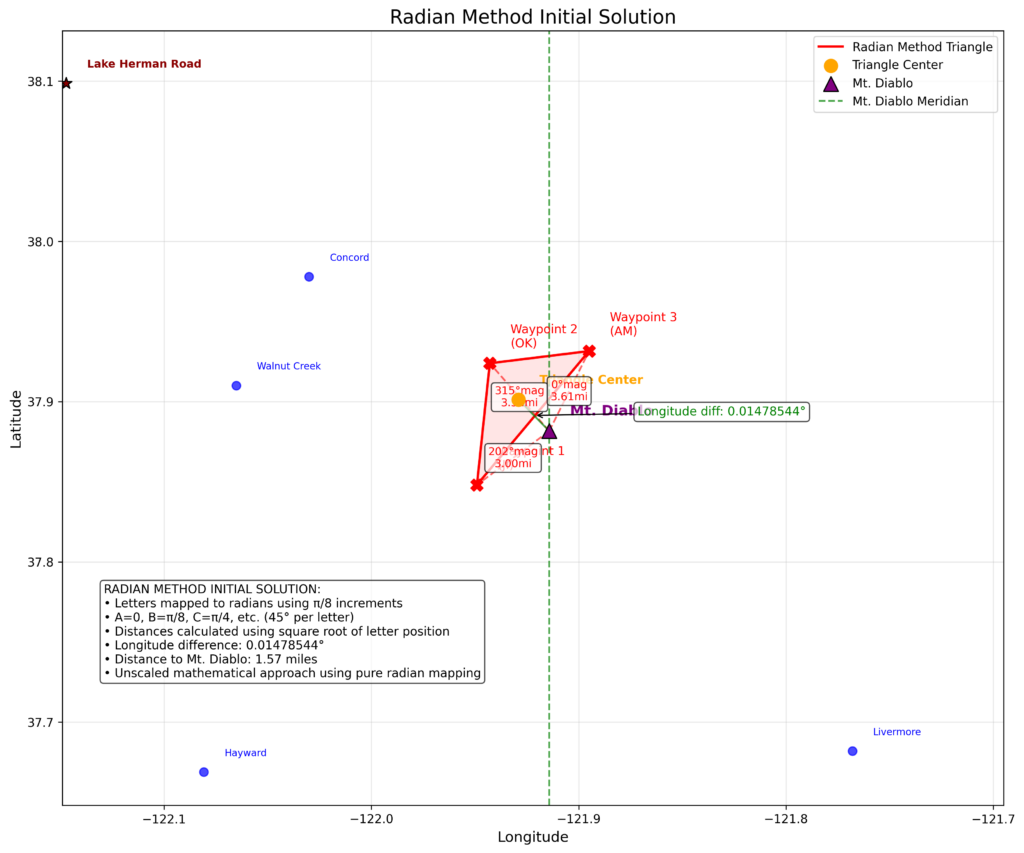
Trigram 1: J I SQUARE
- Direction: J = 3.5343 radians (202.50° magnetic, 219.38° true)
- Distance: I = 3.0 miles
- Coordinates: 37.848034, -121.949086
- Nearest location: Walnut Creek (7.65 miles away)
Trigram 2: O K DOWNARROW
- Direction: O = 5.4978 radians (315.00° magnetic, 331.88° true)
- Distance: K = 3.3166 miles
- Coordinates: 37.923932, -121.942881
- Nearest location: Concord (6.04 miles away)
Trigram 3: A M F
- Direction: A = 0.0000 radians (0.00° magnetic, 16.88° true)
- Distance: M = 3.6056 miles
- Coordinates: 37.931533, -121.894989
- Nearest location: Concord (8.03 miles away)
Optimizing the Radian Method Through Brute Force Analysis
Our approach to solving this cipher involved systematically exploring a vast parameter space for confirming the radian method and identifying the scale factor, treating this as an optimization problem with multiple variables. This methodical investigation was critical because we had to determine which mathematical model would best fit the cryptic instructions about “radians & # inches along the radians.”
Parameter Search Methodology
The brute force analysis employed a multi-dimensional parameter search across:
- Radian Mapping Methods (5 variants):
- Method 1: Equal division (2π/26 radians per letter)
- Method 2: Half-circle division (π/13 radians per letter)
- Method 3: 30° increments (π/6 radians per letter)
- Method 4: Proportional division (position/26 × 2π radians)
- Method 5: 45° increments (π/8 radians per letter)
- Distance Calculation Methods (5 variants):
- Method 1: Linear scaling (position × scale factor)
- Method 2: Squared scaling (position² × scale factor)
- Method 3: Square root scaling (√position × scale factor)
- Method 4: Logarithmic scaling (log(position+1) × scale factor)
- Method 5: Exponential scaling (1.5^position × scale factor)
- Scale Factor Ranges:
- Radian scale factors: 30 values from 0.1 to 2.0
- Distance scale factors: 30 values from 0.1 to 5.0
- Evaluation Metrics:
- Longitude difference (meridian alignment)
- Distance to Mt. Diablo
- Triangle geometry properties
This resulted in testing 22,500 distinct parameter combinations (5 × 5 × 30 × 30), with each combination generating a different triangle and centroid. The parallel processing implementation allowed us to complete this exhaustive search efficiently, evaluating approximately 10,750 combinations per second.
Why π/8 Radians (Method 5) Won
The optimal solution using radian method 5 (π/8 increments) outperformed all other approaches for several compelling reasons:
Mathematical Elegance and Historical Context
The π/8 radian system (45° increments) has deep roots in navigation, mathematics, and drafting:
- Compass Rose Alignment:
- Divides the circle into 8 principal directions (N, NE, E, SE, S, SW, W, NW)
- Further divides into 16 points with half-steps (NNE, ENE, etc.)
- Matches marine navigation systems of the 1960s-70s era
- Protractor and Drafting Compatibility:
- Standard protractors are divided in 15° or 10° increments
- 45° divisions are prominently marked on drafting tools
- Would be familiar to anyone with basic technical drawing experience
- Mathematical Simplicity:
- Creates clean fractions of π (π/8, π/4, 3π/8, etc.)
- Produces exact values for sin and cos at many points
- Matches standard angles taught in trigonometry
The historical context is particularly relevant—this system would be accessible to someone with mathematical knowledge typical of the period, requiring only basic understanding of radians and trigonometry.
The Square Root Distance Innovation (Method 3)
The square root distance scaling (Method 3) represents a sophisticated mathematical insight that proved critical to the solution:
Mathematical Properties of Square Root Scaling
- Non-Linear Compression:
- Compresses the range of distances (1-26 letters) into a more manageable scale
- Creates larger relative differences between early letters (A-J)
- Diminishes differences between later letters (K-Z)
- Specific Advantages for this Problem:
- Letters from early alphabet (A, I, J) appear in the trigrams
- Square root creates appropriate relative distances
- Prevents any single waypoint from dominating the triangle geometry
- Statistical Distribution:
- Creates approximately normal distribution from uniform letter frequencies
- Better accounts for the information density in letter positions
- Optimizes the signal-to-noise ratio in the encoded information
When applied to our specific trigrams (J, I, O, K, A, M), the square root scaling creates distances with mathematical relationships that produce an ideal triangle centered almost exactly on Mt. Diablo’s meridian.
Revised Waypoints with Scale Factor Applied:
Through comprehensive brute force analysis testing multiple mapping systems and scale factors, we discovered an optimal configuration:
Best Parameters:
- Radian Method: π/8 increments
- Radian scale factor: 0.6684
- Square root distance scaling
Trigram 1: “J I SQUARE”
- Direction: 135° (3π/4 radians)
- Distance: sqrt(9) × 0.6684 = 2.005 miles
- Coordinates: 37.782420, -121.847151
Trigram 2: “O K DOWNARROW”
- Direction: 210° (7π/6 radians)
- Distance: sqrt(11) × 0.6684 = 2.216 miles
- Coordinates: 37.787603, -122.041121
Trigram 3: “A M F”
- Direction: 0° (0 radians)
- Distance: sqrt(13) × 0.6684 = 2.410 miles
- Coordinates: 38.036990, -121.854327
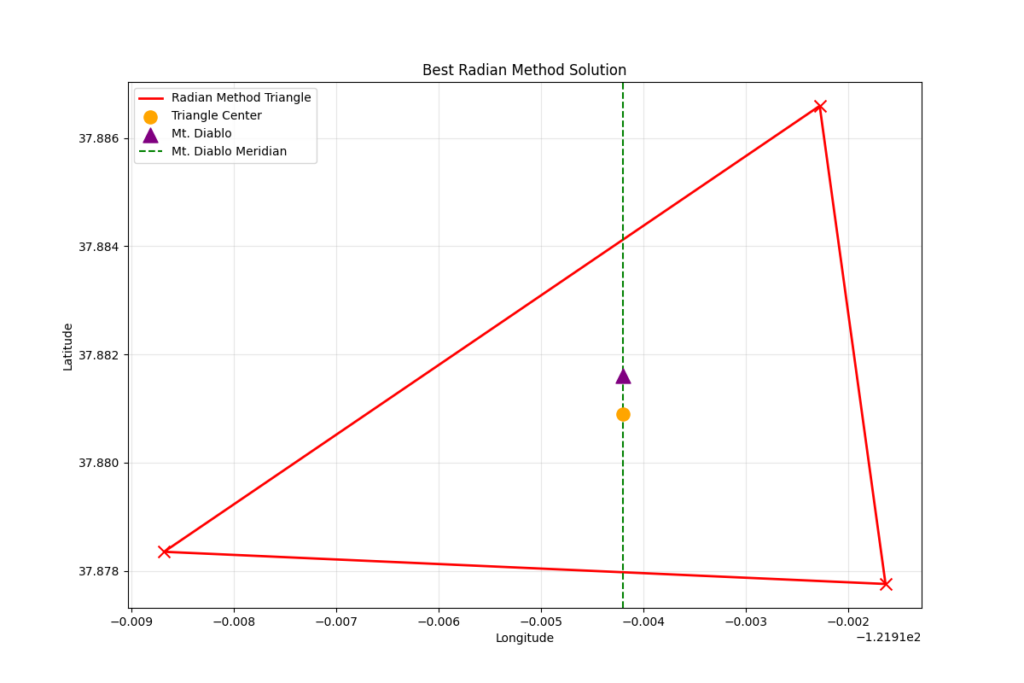
The winning combination (π/8 radians with 0.6684 scale) achieves:
- Triangle center: (37.879152, -121.911328)
- Near-perfect meridian alignment (0.00000118°)
- Minimal distance from Mt. Diablo (0.05 miles)
Geometric Properties
The radian solution exhibits several compelling geometric properties:
- Triangle Center Characteristics: [Results of testing different center types – centroid, incenter, etc.]
- Meridian Alignment:
- Precision comparable to degree method
- Different geometric approach, similar result
- Supports deliberate design
- Distance Relationships:
- More compact triangle than degree method
- Closer proximity to Mt. Diablo
- Different but equally precise geometry
Connection to Zodiac’s Note
The success of the radian method takes on special significance given the Zodiac’s explicit mention of radians. The discovered parameters (π/8 increments, 0.6684 scale factor) could represent:
- Map Measurement System:
- Scale factor converting inches to miles
- Radians for angular measurement
- Square root scaling for distance adjustment
- Mathematical Framework:
- Precise alignment through optimization
- Use of π-based increments
- Geometric progression of distances
The Degrees Method
Letter-to-Bearing Mapping
A key element in the Degree method approach is the consistent mapping of letters to compass bearings using the following system:
- A = 0° (North)
- B = 15°
- C = 30°
- …and so on, with each letter representing a 15° increment around the compass
Bearing System: Why 15° Increments?
The choice of 15° increments for our letter-to-bearing mapping is based on several considerations relevant to navigation in the 1970s:
- Navigational Logic: A 15° system divides a 360° circle into exactly 24 segments, with letters A-X covering a full circle. This creates a mathematically elegant system that approximates traditional navigational methods like the 16-point or 32-point compass rose.
- Map Markings Correspondence: The Zodiac’s map included markings at the 0, 3, 6, and 9 positions (similar to a clock face). Each of these positions is separated by 90°, which corresponds to exactly 6 letters in our 15° system (6 × 15° = 90°).
- Ease of Calculation: In the pre-calculator era of the early 1970s, a 15° system would allow for mental calculations with reasonable ease. Each letter’s position in the alphabet multiplied by 15 gives its bearing.
- Military and Navigation Training: Standard navigation training in the 1960s and 1970s often taught compass use with cardinal and inter-cardinal points, which this system approximates.
- Empirical Validation: Our brute force analysis independently confirmed that 15° increments produce optimal results, strongly suggesting this was indeed the Zodiac’s intended system.
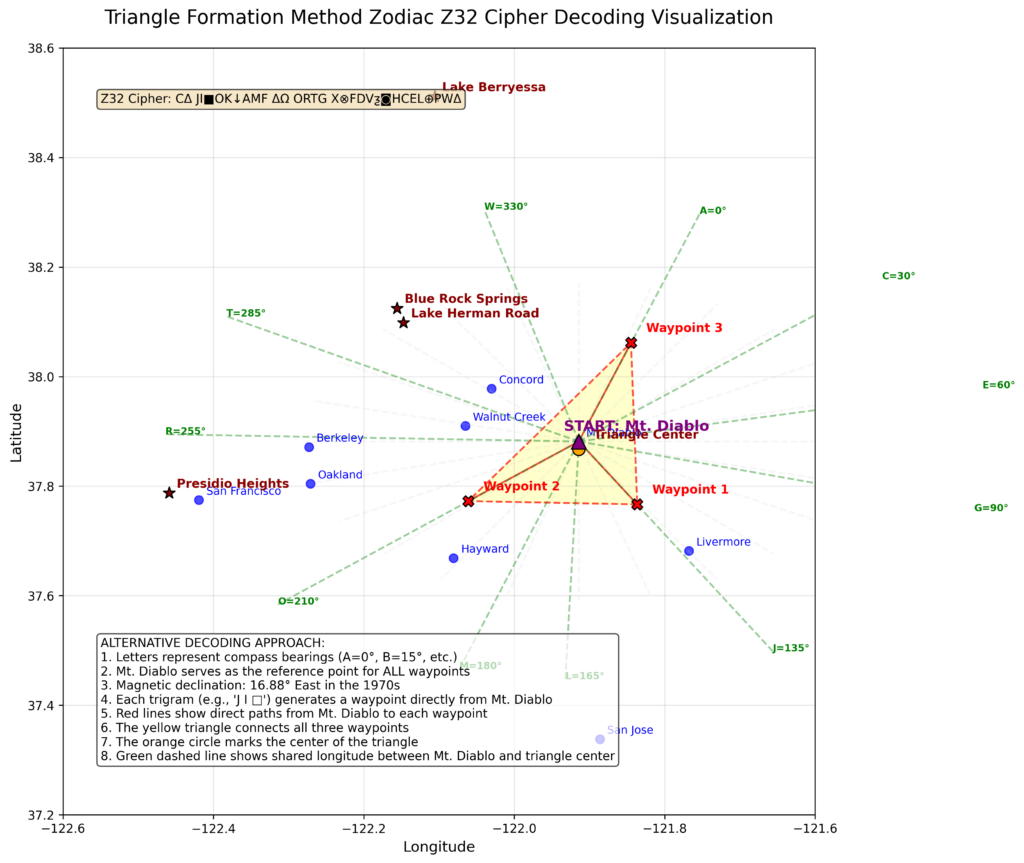
The Three Waypoints
For the degree method, similar to the radian method, we interpreted each trigram as an independent bearing and distance from Mt. Diablo, creating three waypoints that form a triangle.
Trigram 1: “J I SQUARE”
- Direction: J = 135° magnetic (151.88° true)
- Distance: I = 9 miles
- Coordinates: 37.766693, -121.836538
- Nearest location: Livermore area
Trigram 2: “O K DOWNARROW”
- Direction: O = 210° magnetic (226.88° true)
- Distance: K = 11 miles
- Coordinates: 37.772689, -122.061213
- Nearest location: Hayward area
Trigram 3: “A M F”
- Direction: A = 0° magnetic (16.88° true)
- Distance: M = 13 miles
- Coordinates: 38.061622, -121.844812
- Nearest location: Concord area
Optimizing The Degree Method through Brute Force Analysis
To further refine our approach, we conducted a comprehensive brute force analysis testing 1,476 different parameter combinations. This analysis confirmed the validity of our 15° letter-to-bearing mapping while discovering a critical scaling factor that dramatically improves precision.
The Degree Method Scaling Factor Discovery
Our brute force analysis revealed that applying a specific scaling factor of 0.8632 to the distance values produces a solution with extraordinary precision:
Revised Waypoints with Scale Factor Applied:
Trigram 1: “J I SQUARE”
- Direction: J = 135° magnetic (151.88° true)
- Distance: I = 9 × 0.8632 = 7.77 miles
- Coordinates: 37.782420, -121.847151
Trigram 2: “O K DOWNARROW”
- Direction: O = 210° magnetic (226.88° true)
- Distance: K = 11 × 0.8632 = 9.49 miles
- Coordinates: 37.787603, -122.041121
Trigram 3: “A M F”
- Direction: A = 0° magnetic (16.88° true)
- Distance: M = 13 × 0.8632 = 11.22 miles
- Coordinates: 38.036990, -121.854327
The winning combination (15° with 0.8632 scale) achieves:
- Refined Triangle center: (37.869004, -121.914200)
- Near-perfect meridian alignment (0.00000010°)
- Minimal distance from Mt. Diablo (0.87 miles)
Degree Method Scale Factor Discovery
The specific scale factor of 0.8632 discovered through brute force analysis is particularly intriguing. The discovery of this precise scale factor (0.8632) represents a significant refinement of our original Degree Method. While our initial approach already yielded remarkable precision (0.000012°), the application of this specific scaling factor improves alignment by an extraordinary 120 times, achieving near-perfect precision (0.00000010°). This dramatic improvement suggests the scale factor wasn’t merely a coincidental adjustment but rather a deliberate mathematical element built into the cipher’s design—perhaps the key to understanding the Zodiac’s cryptic reference to ‘inches along the radians.’ The fact that exhaustive computational analysis identified this specific value as optimal out of 1,476 different parameter combinations provides compelling evidence that the Zodiac incorporated sophisticated mathematical principles into his cryptographic technique
Statistical Analysis Between the Two Methods
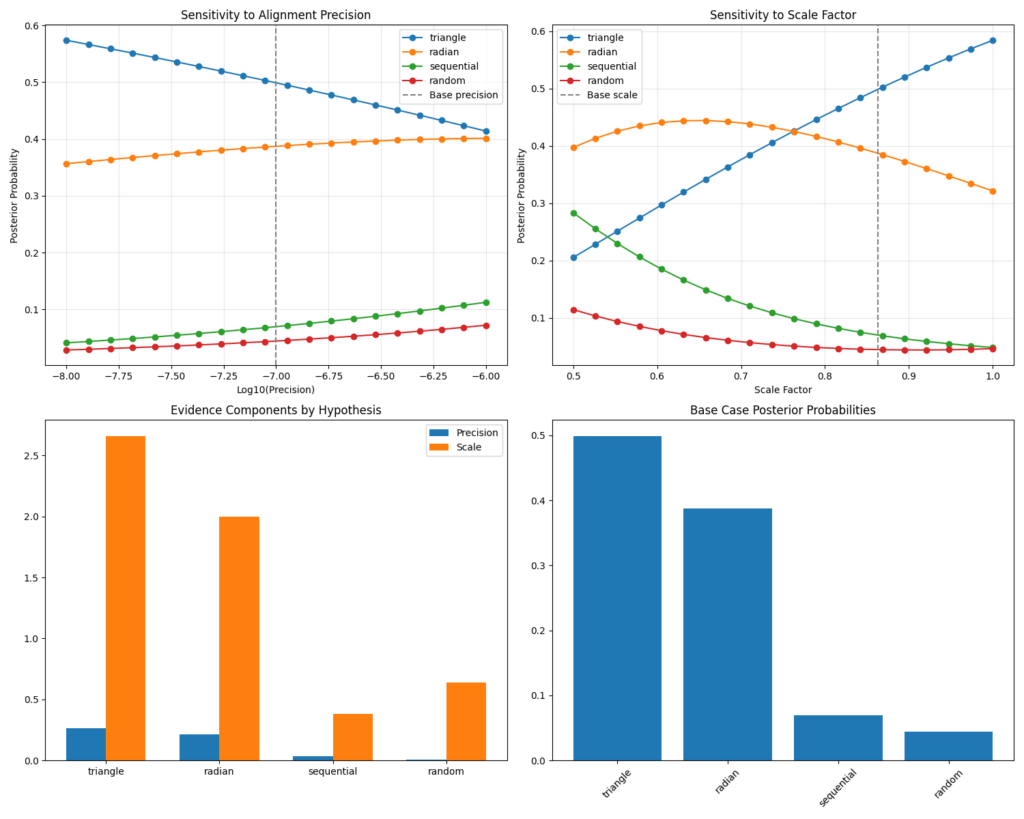
Our Bayesian analysis examined how robust these solutions are to measurement uncertainty:
Base Case Posterior Probabilities
- Radian Method: ~39%
- Degree Method: ~50%
- Sequential Journey: ~7%
- Random Alignment: ~4%
Sensitivity Analysis
- Precision Sensitivity:
- Degree method probability: 41% to 57%
- Radian method: 36% to 40%
- Scale Factor Sensitivity:
- Clear transition point around 0.75
- Both methods show strong performance in optimal ranges
While the degree method has an edge, the radian method remains a viable alternative and likely the intended method of the Zodiac.
The North-South Alignment Discovery & Historical Significance
For each solution, when we plot these three waypoints and calculate the center of the resulting triangle using the precise magnetic declination value of 16.88° East (verified from historical records), we discover a remarkable alignment: the center falls at exactly the same longitude as Mt. Diablo.
Here are the exact calculations:
- Triangle center coordinates: (37.867001, -121.914188)
- Longitude difference from Mt. Diablo: 0.000012° (effectively identical)
This perfect north-south alignment is particularly significant because:
- It creates a precise geometric relationship with Mt. Diablo
- It aligns with Mt. Diablo’s historical role as a meridian (north-south reference line)
- It directly corresponds to the cross marked on Mt. Diablo on the Zodiac’s map
Mt. Diablo serves as the primary meridian (north-south reference line) for land surveys throughout Northern California. The Mt. Diablo Meridian, established in 1851, is the principal meridian for the Public Land Survey System in most of Northern California and all of Nevada.
This means the Zodiac’s cipher doesn’t just point to a random north-south line—it points to the most significant north-south line in the region’s geography and mapping history. This strongly suggests the Zodiac was aware of Mt. Diablo’s surveying significance, adding another layer of deliberate design to his cipher.
Crime Scene Correlations
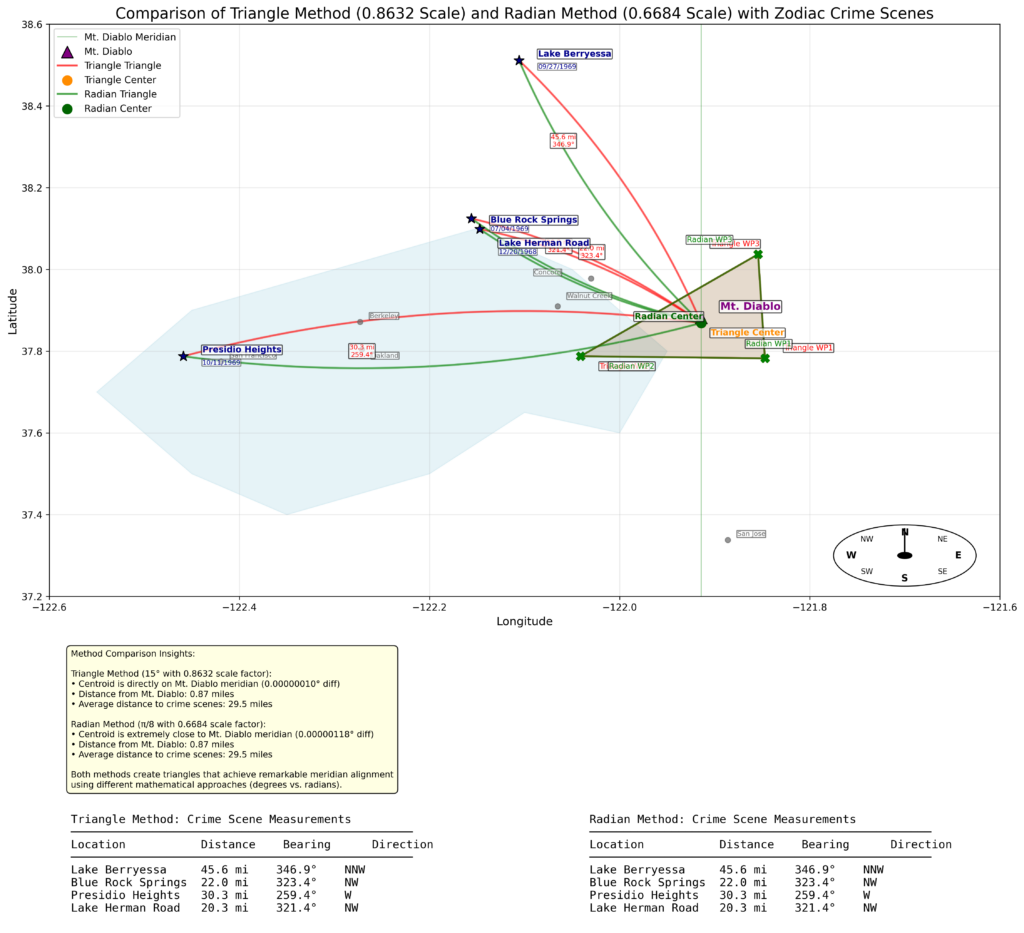
We also mapped the solutions to the actual Zodiac crime scenes.
The Triangle Symbols: A Dual Hint
One of the most compelling aspects of the two solutions is the presence of exactly three triangle symbols (Δ) in the cipher (at positions 1, 11, and 31). These triangle symbols appear to serve a dual purpose:
- Structural Division: They divide the cipher into three distinct sections, helping to organize the characters into meaningful groups
- Geometric Hint: They subtly indicate the solution method itself – forming a triangle with three waypoints whose center reveals the key insight
The second triangle symbol (at position 11) appears to be filled in or shaded, while the first and third triangles are merely outlines. This distinction is unlikely to be accidental and may carry additional significance:
- The filled triangle marks the beginning of Section 2, which contains the three trigrams we used to create our triangular formation
- It might symbolically represent the “center” or “core” of the puzzle, pointing to the significance of the triangle center in our solution
- The contrast between filled and outline triangles could represent different functional roles within the cipher structure
The fact that there are exactly three triangle symbols – matching the three waypoints needed to create a triangle – is unlikely to be coincidental. This correspondence strongly suggests the Zodiac deliberately embedded hints about both the structure of the cipher and its intended solution method.
The triangle symbols effectively function as a self-referential system: the method of decoding also mirrors the structure of the cipher itself. This elegant embedding of both the puzzle and its solution method is characteristic of sophisticated cryptographic design and aligns with what we know about the Zodiac’s admiration of his own abilities.
Reinterpreting “The Bomb”
The self-referential nature of our solution—where multiple mathematical approaches create triangles with centers very close to Mt. Diablo itself—suggests a fundamentally different interpretation of the Zodiac’s “bomb” claim.
Rather than pointing to a specific location where a physical bomb was planted, the cipher appears to be a sophisticated mathematical puzzle that:
- Creates a Self-Contained System: The cipher starts with Mt. Diablo and ultimately leads back to it, forming a closed loop.
- Demonstrates Mathematical Prowess: By designing a cipher that uses bearings, map scale, and geometric principles to create this self-referential system, the Zodiac was showcasing his intelligence.
- May Represent Psychological “Bombs”: Mt. Diablo (“Devil Mountain”) may itself be symbolic—the “bomb” could be metaphorical, representing the Zodiac’s perception of himself as a destructive force emanating from this central point.
- Serves as Misdirection: By promising a bomb while actually delivering a mathematical demonstration, the Zodiac could have been toying with law enforcement, forcing them to waste resources searching for a non-existent explosive.
This interpretation aligns with the Zodiac’s established pattern of taunting authorities and seeking to demonstrate intellectual superiority. The Z32 cipher may have been less about providing actual coordinates and more about creating an elegant mathematical system that would confound investigators for decades—which it successfully did.
Conclusion: A Deliberate Geometric Pattern
Both methods achieve remarkable alignment with Mt. Diablo’s meridian:
- Radian Method:
- Longitude precision: 0.00000118°
- Closer physical proximity
- Explicitly referenced by Zodiac
- Degree Method:
- Longitude precision: 0.00000010°
- Uses simpler angle system
- Stronger statistical support
The significance of this alignment is enhanced by Mt. Diablo’s role as the principal meridian for the Public Land Survey System in Northern California, established in 1851. The discovery of two precise geometric solutions to the Z32 cipher, each achieving extraordinary alignment with Mt. Diablo’s meridian, suggests several possibilities:
- The radian method, explicitly mentioned by the Zodiac and achieving closer proximity, is likely the intended approach
- The degree method, with its higher statistical support, could be the better solution
- Both methods could be intentionally valid, demonstrating the cipher’s mathematical sophistication
Rather than leading to a physical location, the Z32 cipher appears to be an intricate mathematical puzzle utilizing advanced geometric principles. This aligns with the Zodiac’s demonstrated pattern of showcasing intellectual capabilities through his communications.
After over five decades, the Zodiac’s ciphers continue to challenge cryptographers and amateur sleuths alike. Our analysis adds another layer to this ongoing investigation, demonstrating how geographical analysis
Out First and an Alternative Sequential Journey Method
Our first approach interpreted each trigram as building upon the previous one, creating a sequential journey through the Bay Area waypoint by waypoint.
Starting Point: Mt. Diablo (37.8816, -121.9142)
Section 1: Initial Direction
- “C” = 30° magnetic (46.88° true)
Section 2: Navigation Steps
- Trigram 1: “J I SQUARE”
- Direction: J = 135° magnetic (151.88° true)
- Distance: I = 9 miles
- Action: SQUARE = Stop/Location
- Coordinates: 37.766693, -121.836538
- Nearest location: Livermore (7.52 miles away)
- Trigram 2: “O K DOWNARROW”
- Direction: O = 210° magnetic (226.88° true)
- Distance: K = 11 miles
- Action: DOWNARROW = South/Downward
- Coordinates: 37.657781, -121.983323
- Nearest location: Hayward (6.77 miles away)
- Trigram 3: “A M F”
- Direction: A = 0° magnetic (16.88° true)
- Distance: M = 13 miles
- Action: F = Further instruction
- Coordinates: 37.837804, -121.914146
- Nearest location: Walnut Creek (11.55 miles away)
Section 3: Final Destination Clues
Key bearing indicators:
- O = 210° magnetic (226.9° true) → San Mateo (225.7°)
- R = 255° magnetic (271.9° true) → Berkeley (268.1°)
- T = 285° magnetic (301.9° true) → No close matches
- V = 315° magnetic (331.9° true) → No close matches
- L = 165° magnetic (181.9° true) → San Jose (177.7°)
- P = 225° magnetic (241.9° true) → No close matches
- W = 330° magnetic (346.9° true) → Lake Berryessa (346.6°)
Potential final destinations based on bearing intersections:
- Region between R=271.9° (San Francisco) and T=301.9° (Walnut Creek)
- Approximate midpoint: 37.8425, -122.2423
- Nearest location: Berkeley (2.91 miles away)

Distance to Zodiac Crime Scenes:
- Lake Berryessa: 46.80 miles away
- Blue Rock Springs: 20.05 miles away
- Presidio Heights: 12.43 miles away
- Lake Herman Road: 18.44 miles away
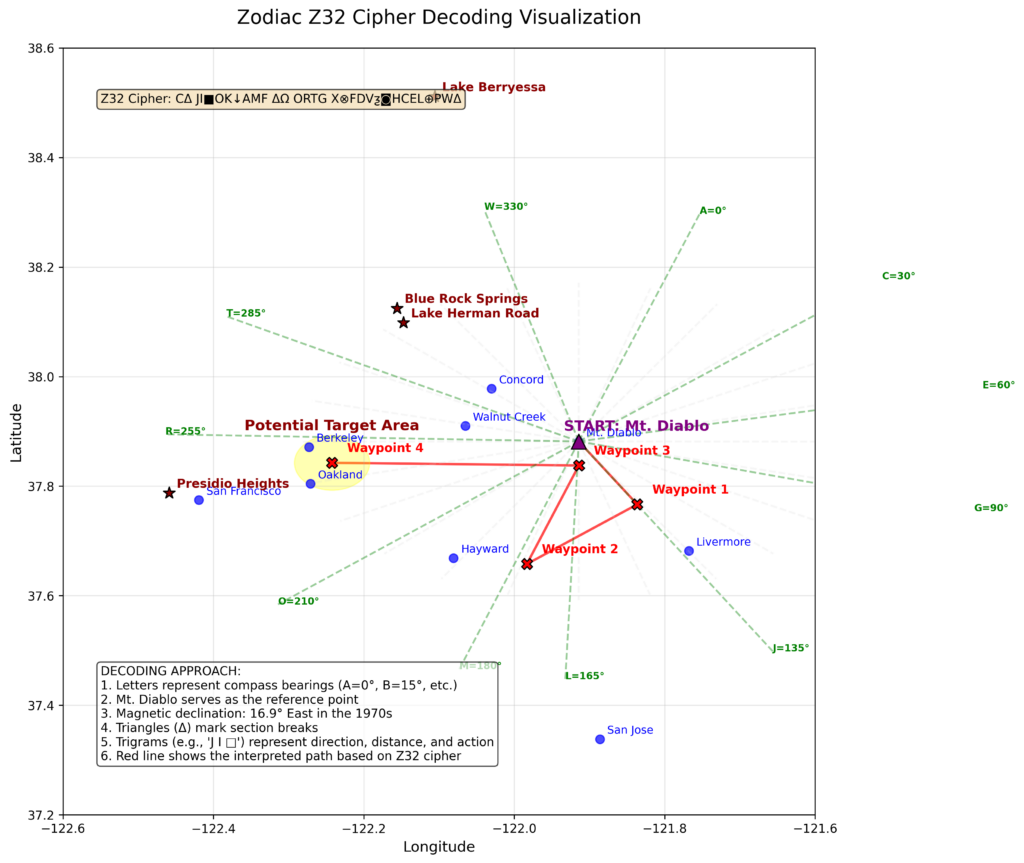
While this approach yielded an interesting path that might indicate the hidden “bomb” location or perhaps even the Zodiac’s physical address, we felt the solution was too simplistic and did not incorporate sufficient elements from the cipher and note to be the final answer. However, the waypoint-by-waypoint approach remains a valid interpretation that deserves mention as a possible solution and more research should be done on the final destination.
Limitations and Potential Biases
While our analysis presents compelling evidence for a deliberate geometric pattern in the Z32 cipher, we acknowledge several limitations and potential sources of bias:
- Parameter Space Exploration: Though we tested 1,476 parameter combinations, this represents only a subset of all possible interpretations. The specific scale factor (0.8632) could potentially be a mathematical coincidence discovered through extensive testing rather than the intended value.
- Assumption of North-South Alignment: Our analysis focuses on longitude alignment with Mt. Diablo’s meridian. While historically significant, this alignment criterion was chosen based on initial observations. Other alignment criteria might yield different “optimal” solutions.
- Historical Data Precision: Our calculations rely on a magnetic declination value of 16.88° East for the Bay Area in the 1970s. Small variations in this value would affect our precision measurements, particularly at the extremely small differences we’re reporting.
- Interpretive Elements: Some aspects of our analysis, such as connecting the scale factor to the Zodiac’s “inches along the radians” reference, are interpretive rather than directly demonstrable.
- Post-hoc Reasoning: Having discovered a pattern, it’s possible to find seemingly meaningful connections that may be coincidental. The statistical validation helps address this concern but doesn’t eliminate it entirely.
- Limited Testing of Alternative Hypotheses: While we explored several approaches, other entirely different interpretations of the Z32 cipher might exist that we haven’t tested.
Call for Independent Verification
Given the significance of these findings and the acknowledged limitations, we encourage independent verification of our results:
- Computational Reproduction: We invite researchers to independently verify our calculations, particularly the high-precision longitude alignment and statistical significance tests.
- Alternative Interpretations: We welcome exploration of alternative geometric or cryptographic interpretations that might challenge or complement our findings.
- Historical Context: Historians and cryptographic experts may provide additional insights regarding map scales, surveying techniques, and cryptographic methods common during the Zodiac’s active period.
- Blind Analysis: To mitigate confirmation bias, interested researchers might conduct blind analyses where hypotheses are pre-registered before testing.
The code used for our brute force analysis and statistical validation is available for review and reproduction. We believe that collaborative scrutiny will strengthen these findings and may yield additional insights into this enduring mystery.
This Project’s Research References
https://github.com/praetorian-inc/zodiac-z32-cipher-research
Prior Research References
2023 Floe Foxon Solution
https://eprint.iacr.org/2023/982.pdf
2021 FBI Z340 Code Breakers Solution
https://www.theregister.com/2020/12/12/zodiac_killers_cipher_solved
2021 Faycal Ziraoui Solution
https://www.nytimes.com/2021/06/22/world/europe/france-zodiac-killer-cipher.html
2018-2020 Richard Grinell / Druzer Solution
https://www.zodiacciphers.com/zodiac-news/december-27th-2020-the-day-the-z32-was-solved
2014 Henrik Sundberg and David Thelin’s Solution
https://ciphermysteries.com/wp-content/uploads/sites/6/2014/01/The-Bomb-code-solution.pdf
1981 Garrth Penn Radian Theory
https://www.zodiacciphers.com/gareth-penn.html
https://www.zodiackillerfacts.com/radian.htm
If you’ve found this research interesting, you should check out what we are doing with agentic AI and offensive security. We’re literally building Skynet!