
Getting Started with Damn Vulnerable Router Firmware (DVRF) v0.1
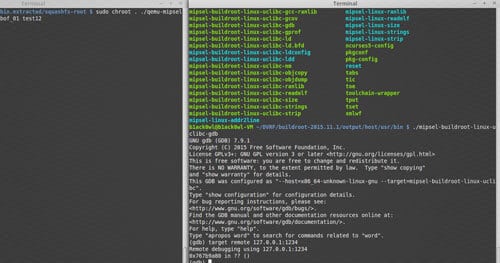
The goal of the DVRF project is to simulate a real-world environment to help people learn about other CPU architectures outside of the x86_64 space. The project will also help people get into discovering new things about hardware. As of now this DVRF firmware is tailored for the Linksys E1550 Device. If you do not have one don’t worry! Ready to get a jump start on learning aspects of embedded device hacking for exploit development? If so, this project is for you.
Group Policy Preferences (GPP) Pwned
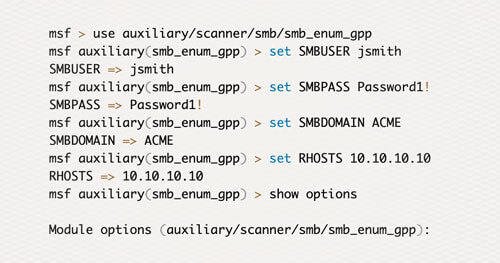
Over the past few months I’ve had a chance to clean up some code that we’ve used internally for penetration testing for some time now. This code was built to demonstrate the weaknesses of using Group Policy Preferences (GPP) to store and distribute local or domain credentials. We have found that many organizations store local admin, domain service, and even Domain Admin account credentials using GPP. The module that I submitted to the Metasploit Github repo provides the ability to enumerate GPP credentials as a domain user with access to the SMB share on the DC. Extracted credentials will be stored in the Metasploit creds tables.
Building the HashCat API in Ruby to Crack Passwords in the Cloud
Have you ever had an amazing idea for automating two or more pieces of technology and then realized one of them doesn’t have an API? I came across this problem more than once during the development of a couple of projects here at Praetorian. In this post, I’ll share some of the libraries and techniques I have used to build out APIs for CLI programs, such as HashCat and nmap. Hopefully, these techniques and libraries will be helpful to you when building out new web applications and frameworks.
Using Developer Debugging Tools to Pentest Mobile Applications
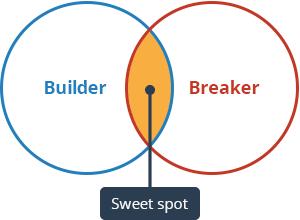
During a recent assessment, I was pentesting a hybrid mobile application that is a companion to a web application. The applications allow users to collaborate while creating new interactive digital content. Through the web interface, content creators are allowed to upload a wide range of files, including HTML files, and share the content with other individuals in their organization. Thus, any user with proper permissions is able to view and edit shared content.
Man-in-the-Middle TLS Protocol Downgrade Attack

A flaw was recently found in OpenSSL that allowed for an attacker to negotiate a lower version of TLS between the client and server (CVE-2014-3511). While this vulnerability was quickly patched, an attacker that has control of your traffic can still simulate this attack today. Let’s explore how this is possible through looking at man-in-the-middle attacks and how browsers handle SSL/TLS connections. In addition, we will see the implications of the attack on cryptographic security.
PHP-CGI Remote Command Execution Vulnerability Exploitation

During a recent penetration test, our team found a few web servers that were vulnerable to a PHP-CGI query string parameter vulnerability (CVE-2012-1823). This vulnerability allows an attacker to execute commands without authentication, under the privileges of the web server. The target environment had very strong egress controls in place. All outbound ports were blocked and only ports 80 and 443 were allowed inbound. This made it difficult to obtain an interactive shell. Therefore, we decided to build a proof of concept exploit script using cURL to execute commands and then take it to the next level by authoring a new Metasploit Module.
MAC Cryptographic Errors and Vulnerabilities in SSO Authentication
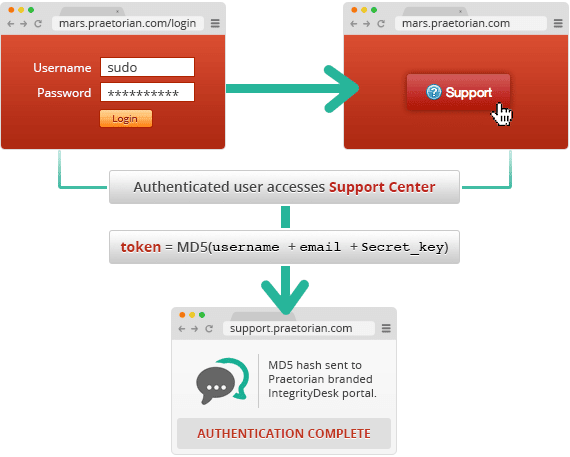
In-house crypto is often a goldmine of cryptographic errors and vulnerabilities. In this post, I’ll describe one of the glaring errors discovered in an online customer support and help desk solution we were considering for use in Praetorian’s cloud-based password cracking service, Project Mars. Hopefully, this can serve as a warning to anyone thinking about writing his or her own crypto libraries.
Exploiting Mobile Banking with HeartBleed Vulnerability

For anyone who has not heard, a critical SSL vulnerability called HeartBleed was made public earlier this week that affects a widely used version of OpenSSL. In this post, I will demonstrate the HeartBleed vulnerability being exploited on a vulnerable mobile banking application and backend server within our test environments.
How to Identify and Prevent UIWebView Cross-Site Scripting

Cross-site scripting occurs when malicious scripts are injected into an otherwise benign or trusted website. Within the mobile security field, cross-site scripting can occur in unlikely places, such as the UIWebView on iOS. For purposes of illustration, we’ll discuss a recent instance of UIWebView cross-site scripting we came across in a test. We’ll also discuss a similar app that does things correctly. Then we’ll cover why problems like this occur and how it’s difficult for developers to foresee these security issues.
How To Identify and Prevent LDAP Injection (Part 2)

LDAP injection occurs when an application fails to neutralize characters that have special meaning in LDAP. Closely, resembling SQL injection, LDAP injection occurs when LDAP statements are constructed with unverified user-supplied data. This can result in the execution of arbitrary commands such as granting permissions to unauthorized queries as well as content alterations within the LDAP tree. The same advanced exploitation techniques leveraged in SQL Injection can be similarly applied in LDAP injection.