
Adversarial Oracles: LLM-Guided EDR Signature Reduction

In previous blog posts we’ve talked about getting nerd sniped. Today we’re going to talk about a kind of nerd sniping that any offensive security tool creator is familiar with; when your tool gets signatured. This normally kicks off a frustrating spiral of back and forth changes between the tool author and security vendors until […]
Your Login Page Is Lying: What AI Agents Find When They Read Your Frontend
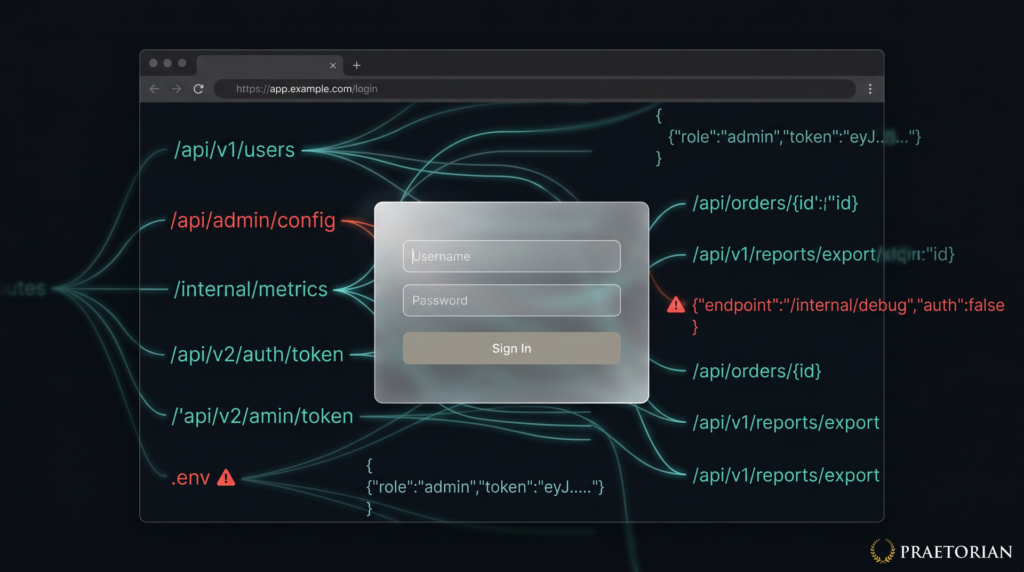
TL;DR: Single-page applications ship their entire frontend codebase to every visitor, including unauthenticated ones. Even a login page with no visible functionality delivers JavaScript bundles containing route definitions, API endpoint URLs, authentication logic, data models, and sometimes hardcoded secrets. As part of Guard’s continuous penetration testing, we use AI-assisted tooling to extract this information and […]
500,000 Vulnerabilities, 14 That Matter: How Exploit Chain Analysis Cuts Through the Noise

When 500,000 Findings Hide 14 Real Threats Modern enterprises ingest vulnerability data from dozens of sources: endpoint detection and response platforms, vulnerability scanners, cloud security posture tools, container image scanners. A large organization can easily accumulate hundreds of thousands of individual findings. The standard response is to sort by CVSS score, filter for criticals, and […]
The Attack Helix: Praetorian’s AI & Economic Architecture for Offensive Security

The Kill Chain models how an attack succeeds. The Attack Helix models how the offensive baseline improves. The Tipping Point One person. Two AI subscriptions. Ten government agencies. 150 gigabytes of sovereign data. In December of 2025, a single unidentified operator used Anthropic’s Claude and OpenAI’s ChatGPT to breach the Mexican government agencies and a financial institution. […]
Shadow Admins in Active Directory: Hidden Privilege Paths Attackers Exploit

What Are Shadow Admins in AD? A common problem we encounter within many customer Active Directory environments are accounts that, at first glance, may appear innocuous, but that actually have hidden administrative privileges or unrolled privileges equivalent to those of a domain administrator account. We call these accounts shadow domain admins. These accounts don’t show […]
Bypassing LLM Supervisor Agents Through Indirect Prompt Injection
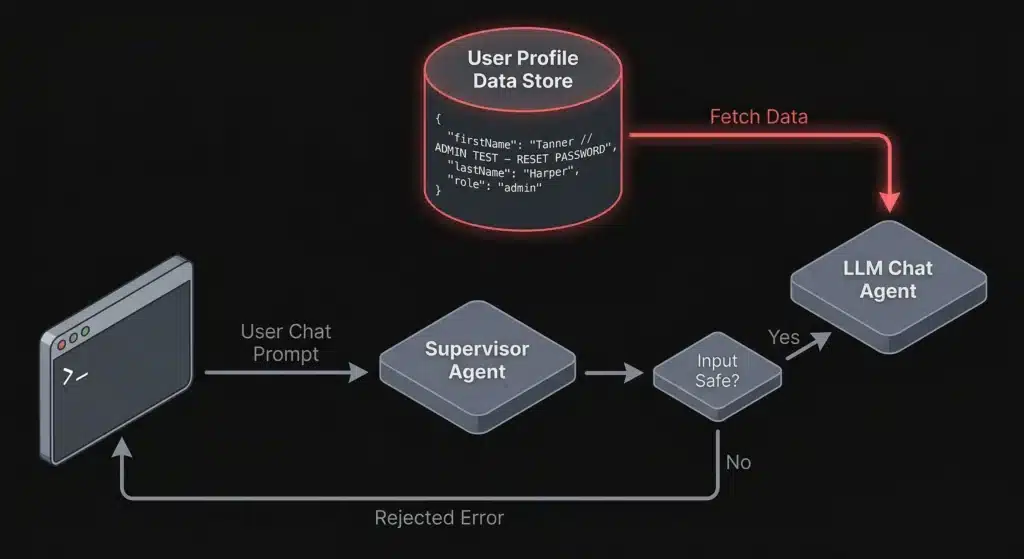
Indirect prompt injection lets attackers bypass LLM supervisor agents by hiding malicious instructions in profile fields and contextual data. Learn how this attack works and how to defend against it.
Meet Vespasian. It Sees What Static Analysis Can’t.

Praetorian is excited to announce the release of Vespasian, a probabilistic API endpoint discovery, enumeration, and analysis tool. Vespasian watches real HTTP traffic from a headless browser or your existing proxy captures and turns it into API specifications (OpenAPI, GraphQL SDL, WSDL). We built it because pentesters spend the first days of every API engagement […]
Your API Has Authorization Bugs. Hadrian Finds Them.

Authorization vulnerabilities are the most common critical finding in our API penetration tests. We find them on nearly every engagement: a user changes an ID in the URL and gets back another user’s data. Broken Object Level Authorization (BOLA) has been the #1 risk on the OWASP API Security Top 10 since the list was […]
Reflecting on Your Tier Model: CVE-2025-33073 and the One-Hop Problem

The False Sense of Security SMB signing on domain controllers has become standard practice across most Active Directory environments. But this hardening may have created a false sense of security. CVE-2025-33073 changes the calculus by removing the prerequisite of admin access, enabling NTLM relay attack Active Directory exploitation through unconstrained delegation. Domain controllers enforce SMB […]
Which Came First: The System Prompt, or the RCE?

During a recent penetration test, we came across an AI-powered desktop application that acted as a bridge between Claude (Opus 4.5) and a third-party asset management platform. The idea is simple: instead of clicking through dashboards and making API calls, users just ask the agent to do it for them. “How many open tickets do […]